Summary
Stored grains and ores represent much more than piles of material in yards or silos; they are raw working capital. For an operations manager, stock controller, or inventory manager, the accurate accounting of these assets is what separates a smooth month-end closing from an unexpected accounting shortfall due to a stockout.
The major challenge, however, lies in the fact that measuring solids on a large scale is an inherently complex task. Unlike liquids, which maintain flat and predictable surfaces, solid bulk materials behave chaotically, creating peaks, troughs, and dead zones that make any visual or manual estimate a high-risk gamble, making high-precision stockpile volumetrics an indispensable tool.
The Invisible Cost of Inaccuracy in Inventory
Errors in volumetric analysis are an invisible cost that silently drains profitability. When a company operates based on approximate data, it exposes itself to discrepancies that can lead to dangerous margins of error.
These discrepancies are very often due to limitations in the technology used. A common method of data capture for volumetrics is photogrammetry, especially due to the ease of capturing images with drones.
This method works by capturing a sequence of overlapping photographs of an object or terrain, taken from different angles and perspectives. Through image processing algorithms, the volumetric software identifies common points between the photos and uses the principle of mathematical triangulation to calculate the depth and three-dimensional coordinates of each point in the image.
However, photogrammetry has technical pitfalls. Because it is a passive method that relies on reflected light and material texture to reconstruct the digital model, it often fails on very homogeneous surfaces, such as piles of clean soybeans or fine ore.
Similarly, clouds of particles generated during the loading of grains and ore can obscure the material pile and confuse the software, causing it to see contours and volumes that do not exist. In these cases, the software attempts to compensate for surfaces where it finds no contrast by using estimates to overcome ambiguities, creating volumetric errors that can have a significant accounting impact, which occurs in two ways.
Short-Term Impact
Imagine a company sells 100,000 tons of soybeans to a client, believing it has that volume in stock. However, due to small errors that accumulate over time during the inventory process, the amount of material available is lower: in reality, there are only 95,000 tons. This is the dreaded “stockout”.
To avoid losing the client or incurring a multimillion-dollar fine for breach of contract, the company now has to make an emergency purchase, acquiring these 5,000 tons at market price to fulfill the order. If this occurs during an off-season period, it will end up paying much more for this product than it would during the harvest. Or a seller, sensing the “desperation,” might take advantage and charge more for the product, knowing that the company doesn’t have many alternatives. In any case, its profit margin ends up being reduced.
A lack of precision also compromises the entire logistics strategy. Hiring freight services to transport non-existent volumes or, worse, being surprised by a lack of material to load a ship that is already docked, generates demurrage costs and contractual penalties that quickly erode profit margins.
Long-Term Impact
In a company’s balance sheet, inventory is classified as a Current Asset. This means that it is considered an asset that the company intends to convert into cash (through sale) in the short term.
An inventory error directly reduces EBITDA.(Earnings Before Interest, Taxes, Depreciation, and Amortization), which is the metric most used by investors to measure a company’s operational efficiency. For the market, a lower EBITDA due to inventory errors signals poor operational management.
Furthermore, overestimating current assets masks the company’s true financial health, as the company’s apparent ability to pay its short-term debts decreases. The value of net working capital also falls, which can make it difficult to obtain loans or reduce the valuation of the company in an audit.
The High-Precision Solution
There is another method for data capture that is not influenced by environmental factors, such as lighting, nor by material characteristics, such as its granularity. It works by combining LiDAR, an acronym for Light Detection and Ranging with a technique called SLAM, an acronym for Simultaneous Localization and Mapping.
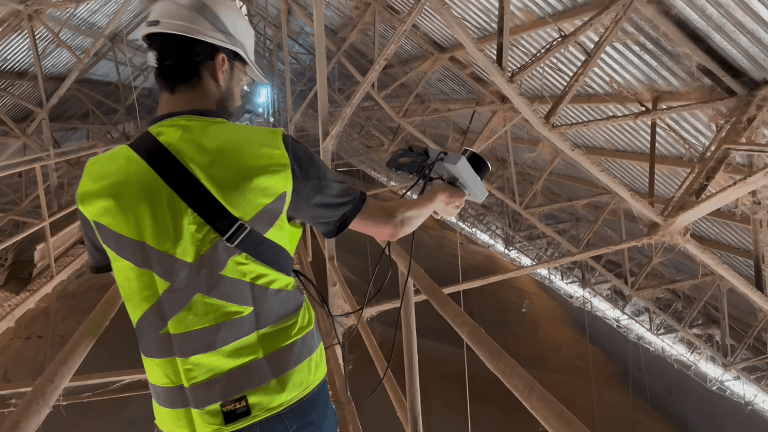
In this method, a portable LiDAR scanner emits a rapid pulse of laser light and measures the time it takes for this pulse to reach a target (the pile of material we want to measure) and return. Knowing this time, and the speed of light in air, it is possible to calculate the distance to the point with extreme precision.
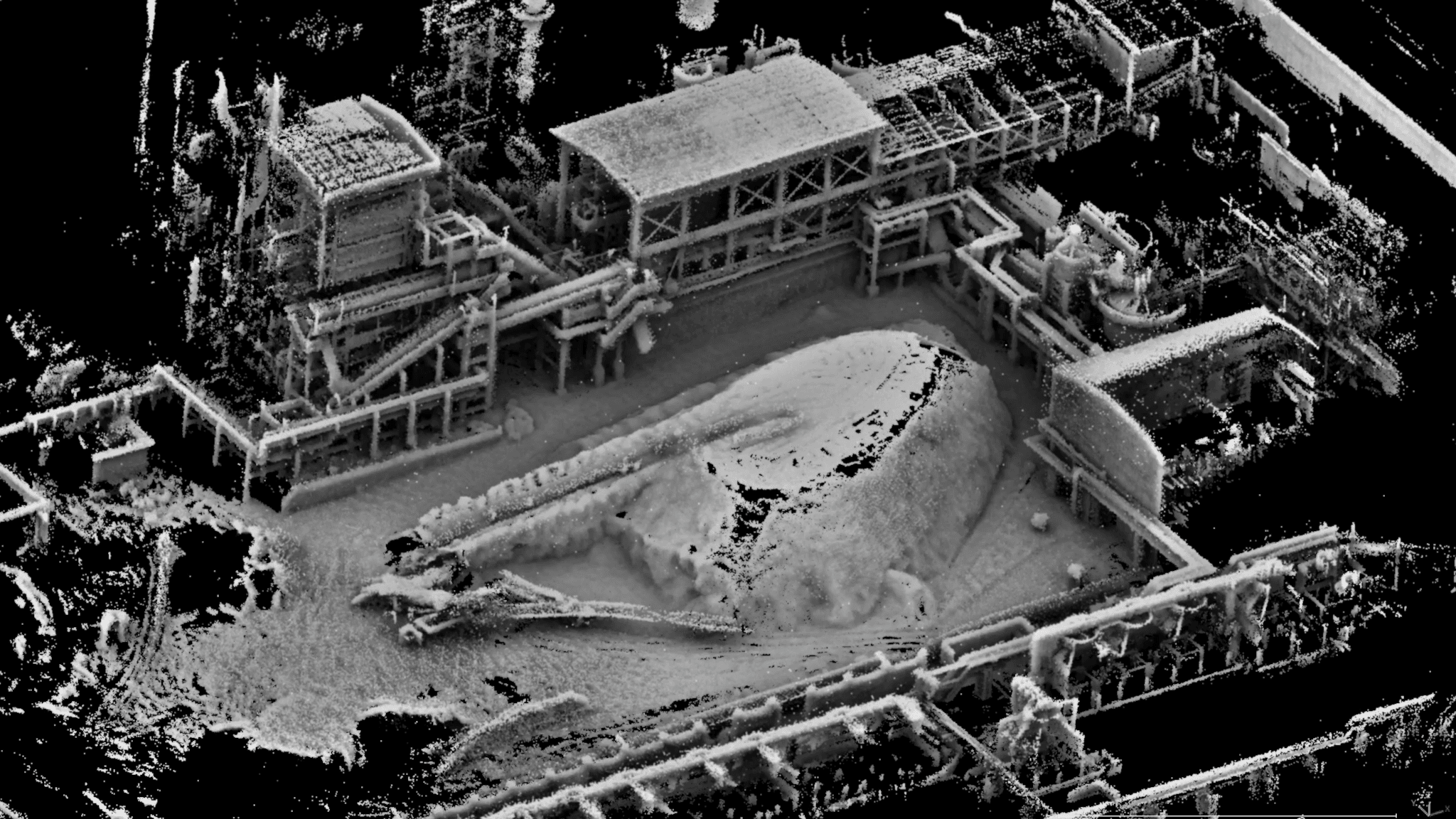
This process is repeated millions of times, generating a “cloud” of points that have a three-dimensional location in space. The denser the cloud, that is, the more points per square meter the LiDAR can capture, the more accurate the representation of each irregularity, hole, or peak in the pile of grains will be.
From there, the volumetric software uses SLAM algorithms to transform this point cloud into a three-dimensional map with the exact dimensions and volume of the scanned area. Knowing the volume and density of the material that makes up the pile, it is possible to accurately calculate the amount of material stored.
The secret to good results lies in the balance between the quality of the point cloud and the selection and fine-tuning of the SLAM algorithm, something that depends on the experience of the equipment operators and service providers.
Increase Operational Safety and Prevent Critical Errors
Avoiding stockouts is perhaps the most tangible benefit of high-precision volumetric analysis for business continuity. After all, small deviations accumulated throughout the year can result in a critical shortage of thousands of tons at the end of the production cycle.
LiDAR precision allows companies to reduce their safety stock levels, freeing up working capital that was previously tied up purely as a precaution. With accurate data at hand, the supply manager can schedule purchases and sales with surgical precision, eliminating production stoppages due to lack of supplies and emergency purchases.
In summary, LiDAR transforms the volumetric data of an uncertain operational task into a generator of strategic intelligence, ensuring that every ton declared on the balance sheet is exactly what is present in the yard.