Sumário
The facilities segment plays a strategic role for companies and institutions, being responsible for ensuring that physical facilities and support services operate efficiently, safely, and sustainably.
In a scenario marked by constant operational challenges, such as the scarcity of qualified labor and the growing need for cost optimization, the adoption of innovative technologies has proven essential to maintain competitiveness.
Among the technological innovations transforming facilities management, computer vision stands out as a promising solution. The technology’s ability to interpret images and data in real-time allows for intelligent environmental monitoring, predictive maintenance, and process automation, contributing to cost reduction and increased productivity.
In this article, we will explore how computer vision can be applied to overcome the main challenges in the facilities sector, bringing concrete benefits and opening opportunities for more modern, efficient, and data-driven management.
The facilities segment plays a strategic role for companies and institutions, being responsible for ensuring that physical facilities and support services operate efficiently, safely, and sustainably.
In a scenario marked by constant operational challenges, such as the scarcity of qualified labor and the growing need for cost optimization, the adoption of innovative technologies has proven essential to maintain competitiveness.
Among the technological innovations transforming facilities management, computer vision stands out as a promising solution. The technology’s ability to interpret images and data in real-time allows for intelligent environmental monitoring, predictive maintenance, and process automation, contributing to cost reduction and increased productivity.
In this article, we will explore how computer vision can be applied to overcome the main challenges in the facilities sector, bringing concrete benefits and opening opportunities for more modern, efficient, and data-driven management.
The main challenges to be overcome by the facilities segment
The facilities segment faces a series of complex and interconnected challenges that directly impact the efficiency and quality of the services provided. One of the main obstacles is the scarcity of qualified labor, aggravated by factors such as low wages, high turnover, and competition with other, more flexible forms of work. This shortage compromises the quality of essential services, such as cleaning, maintenance, and security, and overburdens existing professionals.
Another significant challenge is the growing complexity of properties and facilities, which demands personalized solutions to meet varied needs, from old buildings to modern, intelligent constructions. Companies need to find ways to optimize resources, reduce costs, and ensure sustainability, all while maintaining service continuity and quality.
Furthermore, the sector must rapidly adapt to changes caused by hybrid and remote work, implying the need to flexibilize physical space, review internal policies, and implement technologies that support these new models. Digitization and the integration of smart systems, such as predictive maintenance and data-driven management, are imperatives, but also present technical and cultural challenges for organizations.
Finally, sustainability emerges as an essential requirement, including circular economy practices, energy efficiency, and socio-environmental responsibility, which need to be incorporated into facilities management in a way that is aligned with broader corporate goals. These multifaceted challenges demand innovative solutions that combine technology, strategic management, and continuous training to prepare the sector for the future.
How computer vision helps overcome the challenges faced by the facilities sector
Computer vision offers the facilities sector various practical applications that directly impact the efficiency, safety, and sustainability of operations.
One example is in security. Cameras connected to Edge AI systems, such as dtLabs’ AIOS, enable 24/7 environmental monitoring without human intervention. This alone reduces operational costs, increases monitoring effectiveness (eliminating “blind spots” caused by distractions or shift changes), and eliminates human errors.
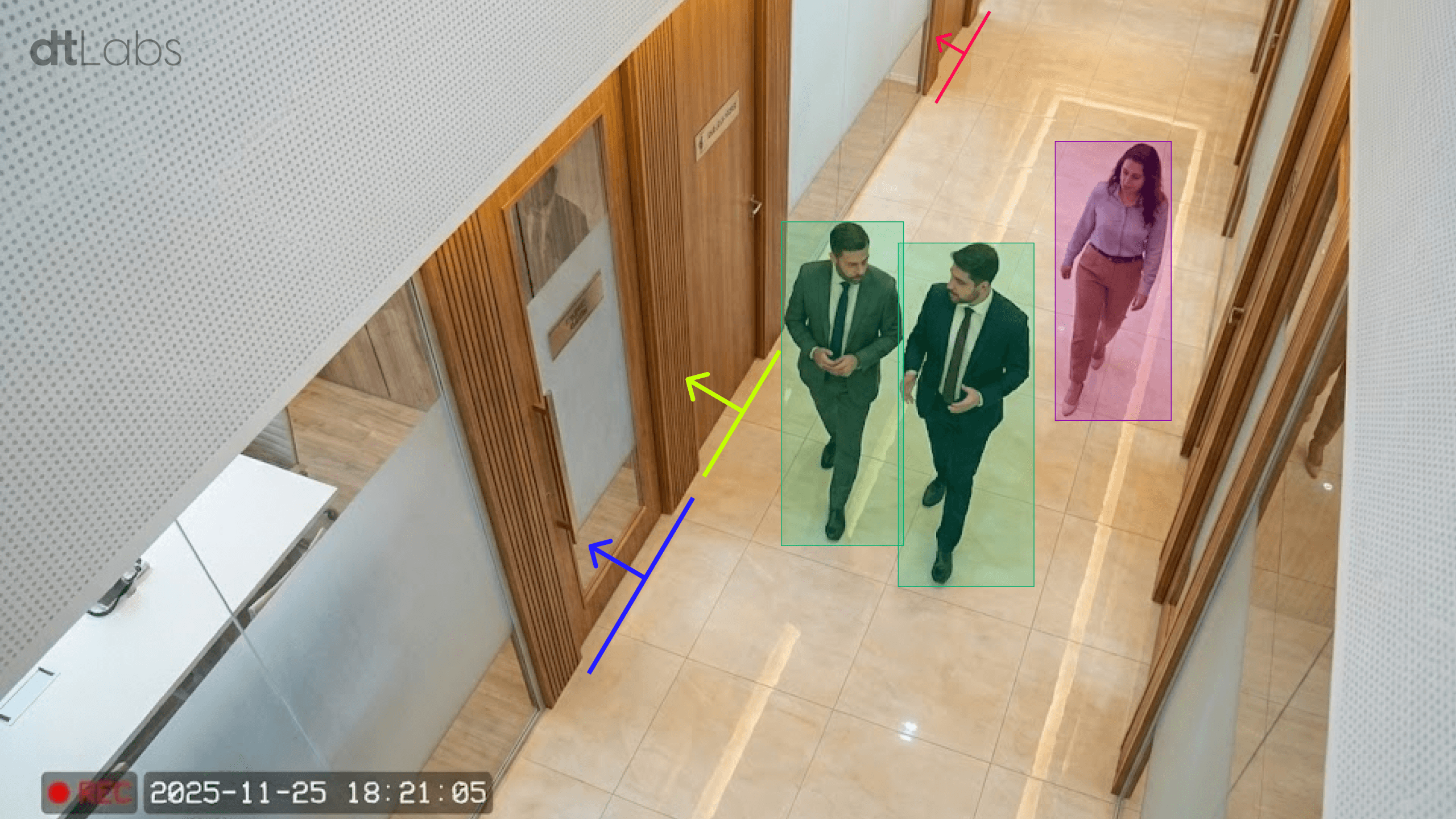
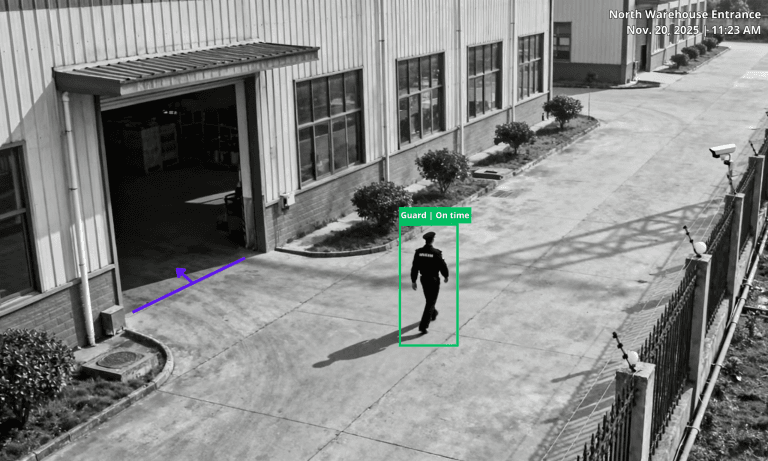
And even where humans are necessary, computer vision can enhance efficiency. For example, by monitoring the adherence to routes and schedules of surveillance teams’ rounds, and issuing automatic alerts in case of non-compliance.
Another example is the use of facial recognition technology in access control. It not only increases the security of the process, since, unlike badges, faces cannot be lost or cloned, but also optimizes the operational aspect, eliminating the need to issue and collect physical badges, thus reducing costs.
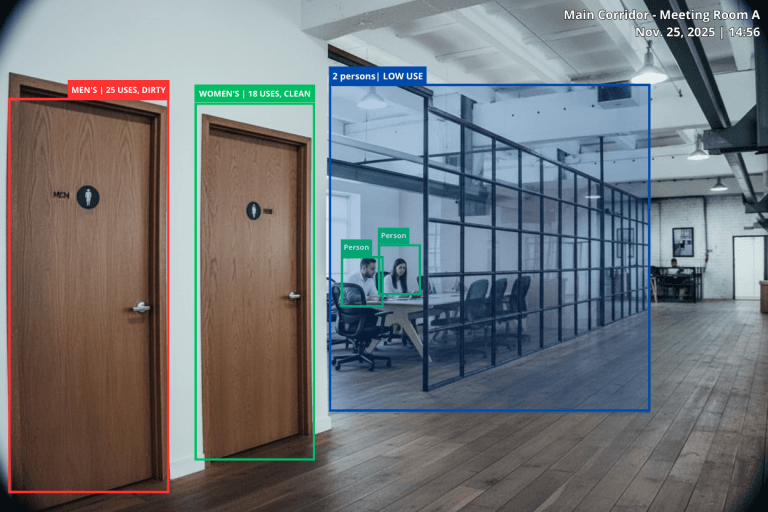
Maintenance and cleaning teams can also benefit. Cameras can immediately alert about defective lighting, and even make the restroom cleaning routine more flexible: instead of “tying” a team to a fixed schedule, displacing employees whether cleaning is needed or not, it is possible to monitor real demand.
A camera monitoring the restroom entrance and a simple counter can generate an alert after a set number of visits, signaling that cleaning is necessary. The same system can even indicate whether the restroom is empty or not, pointing out the exact moment the team should take action.
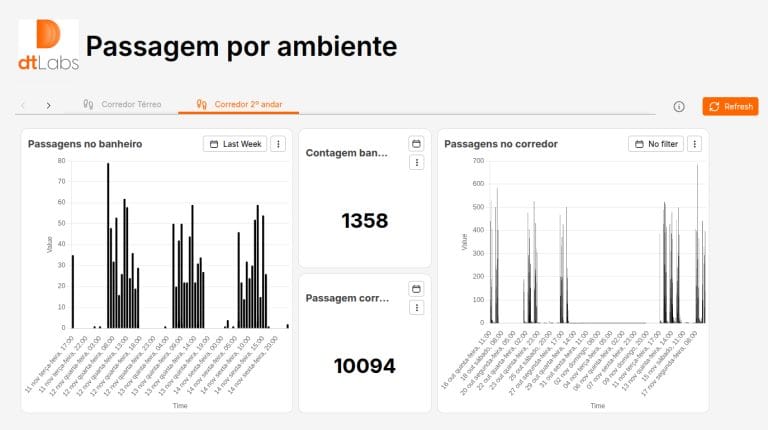
Similarly, counters and “heat maps,” which monitor the presence of people in a space over time, can be used to reduce energy consumption. For example, by turning off the lights in empty spaces or sending a signal to an air conditioning system to lower the power in a little-used room.
Benefits and concrete results of computer vision in facilities management
The implementation of computer vision in the facilities sector has brought concrete and measurable benefits, transforming the way operations are conducted.
One of the main gains is the significant reduction in operational costs, a consequence of the automation of manual processes and the optimization of resource allocation according to real demands, preventing teams from being under- or over-sized.
Another fundamental benefit is the increase in physical security and compliance with regulatory standards. Computer vision systems monitor the adherence to protocols in real-time, such as the correct use of personal protective equipment and access control, minimizing risks and promoting safer work environments. The precision and speed in detecting irregularities enable immediate responses, reducing human errors and improving process reliability.
In addition, the technology improves the experience of users and employees, preventing discomforts such as closed restrooms during peak hours, “freezing” rooms upon arriving for a meeting, and long queues in the cafeteria.
With precise, real-time data, managers can make more informed strategic decisions, promoting energy efficiency and sustainability—elements that also contribute to the institutional image and alignment with broader corporate goals.
Thus, computer vision presents itself as a competitive differential for companies seeking innovation and operational excellence in the facilities sector.
Conclusion
Computer vision emerges as a revolutionary technology for the facilities sector, offering concrete solutions to the traditional challenges faced by this area. By enabling intelligent monitoring, predictive maintenance, and process automation, it not only increases operational efficiency but also elevates safety and sustainability standards.
With the continuous generation of precise, real-time data, managers can make more assertive and strategic decisions, promoting corporate environments that are more productive, safe, and aligned with contemporary demands.
This technological transformation represents a unique opportunity for companies and institutions to modernize their operations and gain a competitive advantage in an increasingly demanding market. Investing in computer vision in the facilities sector is not just a matter of innovation, but a necessity to ensure sustainability, efficiency, and quality in the services provided, aligning facilities management with future market trends and challenges.