Summary
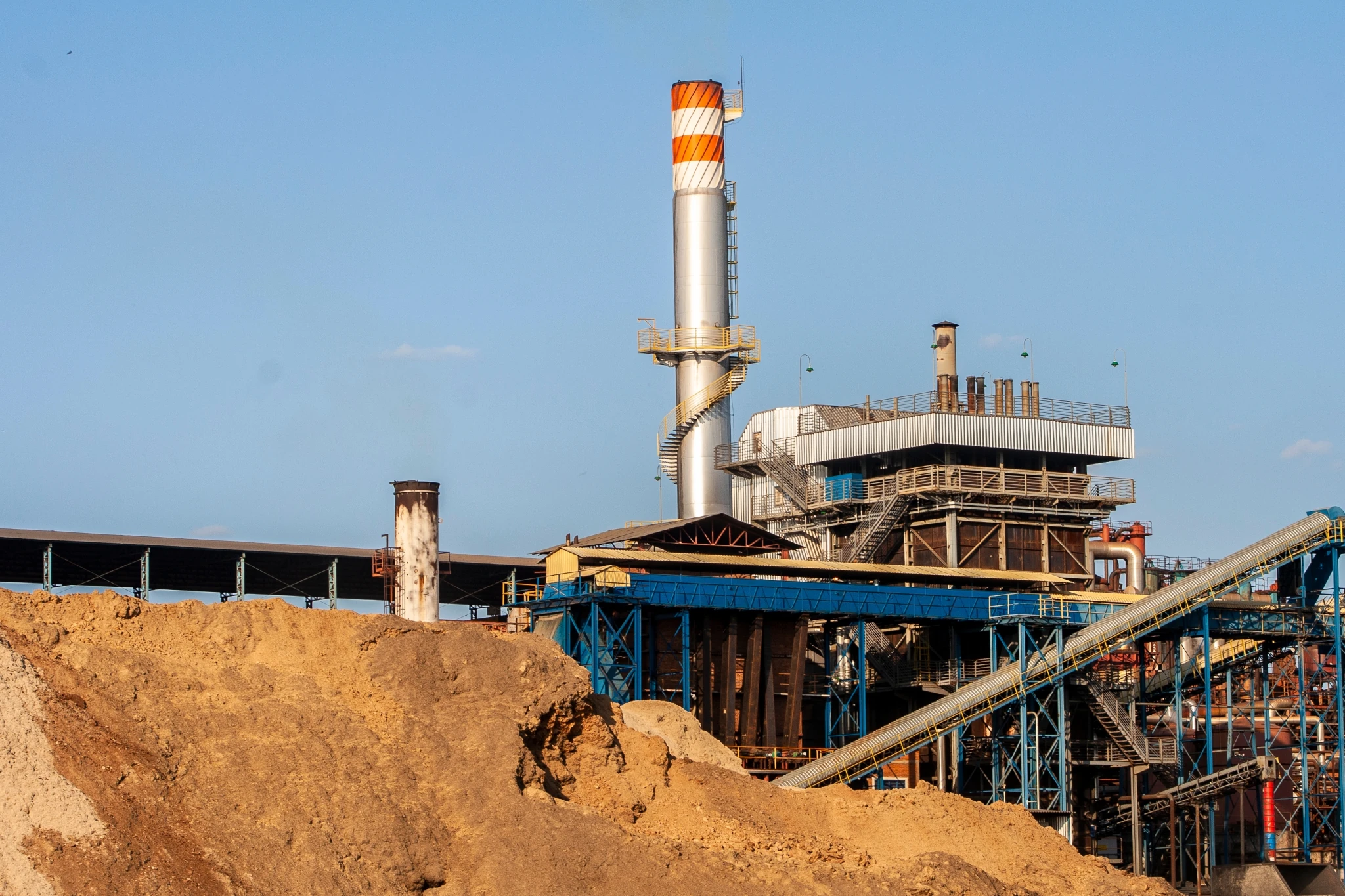
The ongoing pursuit of energy efficiency and sustainability has established biomass—such as wood chips and sugarcane bagasse—as one of the most promising renewable alternatives for industrial power self-generation. However, the transition to this cleaner energy mix brings a monumental logistical challenge: managing massive volumes of bulk material, which require extensive storage yards, large storage sheds, or silos.
Solid biomass possesses highly challenging physical characteristics. It is a highly irregular, heterogeneous fuel with low energy and bulk density. In practice, this means industries must move and stockpile a colossal amount of physical material to ensure the required energy output. As a result, stockpiles assume complex and shifting geometries, filled with irregularities that complicate the actual physical inventory control of the raw material.
In a continuous production environment, inaccuracies or delays in the volumetric measurement of these stockpiles cease to be mere mathematical rounding errors and become a critical risk for the plant. Working with outdated or distorted data regarding available fuel volume leads to direct planning failures and can trigger severe operational losses. Therefore, adopting processes and technologies that guarantee rapid, agile, and accurate inventory control is a fundamental premise to ensure operational safety, continuous combustion efficiency, and the viability of self-generated power.
Stockpile Dynamics
It is a common mistake to treat a bulk biomass yard as an inert storage facility. In reality, a wood chip or bagasse stockpile is an intensely dynamic and “living” environment. Due to the inherent moisture of the material and continuous exposure to the elements, biomass becomes the perfect substrate for the proliferation of fungi and bacteria. This microbial activity consumes the nutrients and carbohydrates in the wood to survive, generating heat and producing water as byproducts of its metabolism.
The direct impact of this biological degradation is what is known as dry matter loss. Studies by the International Energy Agency (IEA) indicate that wood chip stockpiles can lose between 0.3% and over 5% of their dry mass each month they are left exposed in the yard. This degradation silently destroys the energy potential of the biomass, drastically reducing the useful heat that reaches the plant’s boiler.
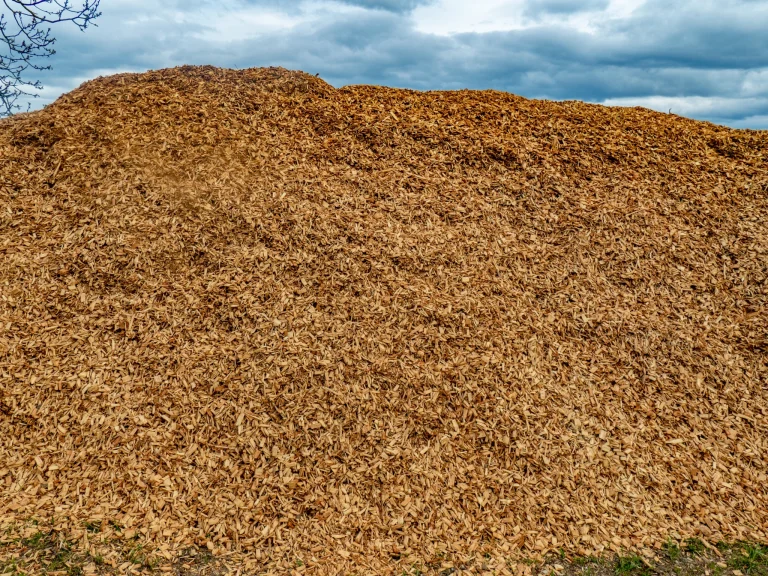
Beyond biological consumption, the stockpile undergoes constant physical and geometric changes. The immense weight of the stored material causes progressive compaction in the lower layers. It is estimated that the compaction rate is 0.6% for every 0.3 meters of stockpile height.
As a result, the apparent volume of the stockpile continuously changes, even though the actual amount of energy (mass) remains the same, creating severe distortions in the visual perception of the inventory.
The Critical Need for Rapid Measurement
Faced with a raw material that shrinks, degrades, and shifts in shape and weight every day—coupled with the continuous and aggressive consumption of the boilers—the time factor becomes the greatest bottleneck in management.
Traditional topographic surveying systems simply cannot keep up with this pace. Technical literature demonstrates that a conventional survey using precision GPS (RTK GNSS) can require an operator to walk for about 8 hours over the material just to map a large area. When factoring in office processing time, the final volume report can take days to reach the manager.
The core problem is that this data is already outdated the moment it is generated. By the time the volume is finally calculated, the physical reality of the yard has already changed. For this reason, biomass management demands abandoning slow measurements in favor of agile, real-time technologies.
The Operational and Financial Losses of Inaccurate Measurement
In industrial dynamics, Production Planning and Control (PPC) uses the biomass inventory as a vital buffer to ensure that supply fluctuations or delays do not affect the mill. However, when volumetric measurement is inaccurate and overestimates the amount of material in the yard, it creates the dangerous scenario of “false inventory.”
Relying on distorted data in the system, the plant can be caught off guard by a sudden feedstock shortage, culminating in the worst-case operational scenario: a feed interruption and boiler shutdown. For an industry focused on self-generation, a power outage paralyzes overall manufacturing operations. The losses are immediate and severe, forcing the company to bear extremely high downtime costs, in addition to causing thermal and mechanical wear and tear on equipment that will require unplanned corrective maintenance.
Concerned about the catastrophic risk of a plant shutdown, many managers try to compensate for slow and inaccurate measurements by operating with an excessive fuel safety margin. The problem is that maintaining oversized stockpiles drastically increases operational handling and storage costs.
Furthermore, this excess volume represents tied-up capital—it is, quite literally, the company’s money “frozen” in the yard. Worse still, as seen in the previous section, biomass is a material that undergoes severe biological degradation. Therefore, this hidden capital does not just sit idle; it loses heating value and energy efficiency with every additional day spent exposed to the elements, eroding the operation’s profitability.
The Solution: Mobile LiDAR Combining Agility and Precision
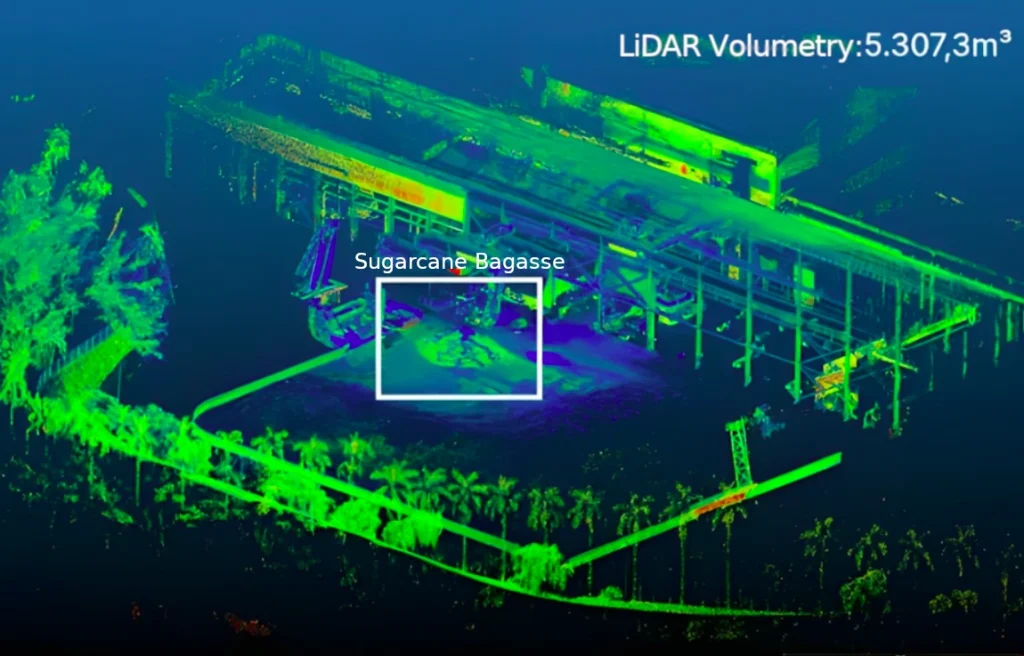
To overcome surveying delays and the risk of “false inventory,” the industry has been adopting mobile laser scanning—specifically, handheld LiDAR (Light Detection and Ranging) devices equipped with SLAM (Simultaneous Localization and Mapping) technology. The operator simply walks around the biomass stockpile while the sensor emits laser pulses, capturing a dense and accurate 3D point cloud of the environment in real time and on the move.
The key differentiator of this technology is its extreme modular flexibility. The same handheld LiDAR device can be carried by an operator walking through a storage shed, lowered by a cable to map the internal volume of a confined silo, or easily mounted on a drone (UAV) to fly over and map massive outdoor yards.
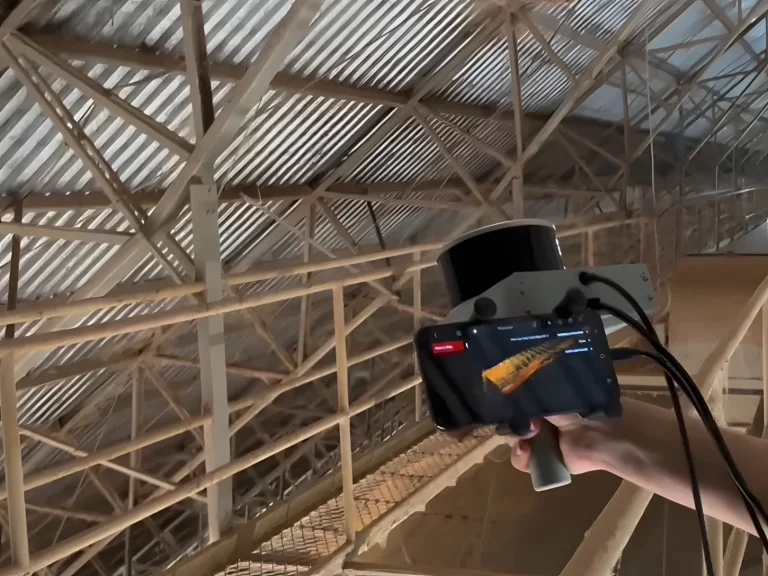
Compared to techniques such as drone-based aerial photogrammetry, SLAM-based LiDAR offers distinct advantages that solve critical bottlenecks in biomass management.
Traditional photogrammetry fundamentally relies on clear lighting and a strong satellite (GPS) signal to align images. This makes it impractical for inventories stored inside indoor sheds or dark silos. Mobile LiDAR is entirely independent of lighting conditions (as it emits its own laser light) and does not require a satellite signal, seamlessly mapping confined spaces and restricted-access environments.
Speed is another key highlight. Photogrammetric image processing requires high-performance computers and can take hours (or days) to convert photos into a 3D model. In contrast, SLAM LiDAR algorithms process the point cloud continuously, allowing the team to visualize the three-dimensional model of the stockpile instantly—or within a few minutes—while still on-site.
Finally, by replacing the traditional method (where the surveyor had to walk over an unstable material stockpile) with mapping conducted from a safe distance, mobile LiDAR drastically mitigates ergonomic risks, engulfment hazards from stockpile collapses, and workplace accidents involving heavy machinery in the yard.
Conclusion
In bioenergy self-generation, having total control over solid feedstock is the lifeblood that ensures operational continuity. Treating bulk biomass as a static inventory or attempting to manage it with time-consuming metrics is an open invitation to planning failures, tied-up capital, and, in the worst-case scenario, a complete power plant shutdown.
By overcoming the bottlenecks and delays of traditional surveying, as well as the limitations of photogrammetry in indoor environments, the adoption of mobile LiDAR establishes a new and definitive standard for flexibility and reliability. In an environment where energy efficiency dictates industrial profitability, combining real-time precision and agility is no longer a technological luxury. Today, it is a critical prerequisite for survival, safety, and financial optimization in biomass inventory management.